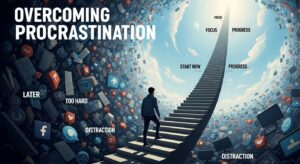

It’s 5 p.m. and you’ve just realized that report you’ve been putting off is due tomorrow. It’s time to buckle down, open your computer… and check your phone. Maybe catch up on your favorite YouTube channel? Actually, you should probably make dinner first. You usually like cooking, though it’s hard to enjoy with this work hanging over your head, and oh— it’s actually pretty late!
Maybe you should just try again in the morning? This is the cycle of procrastination, and I promise you, we have all been there. But why do we keep procrastinating even when we know it’s bad for us? To be clear, putting something off isn’t always procrastinating. Responsible time management requires deciding which tasks are important and which ones can wait.
 Procrastination is when we avoid a task we said we would do, for no good reason, despite expecting our behavior to bring negative consequences. Obviously, it’s irrational to do something you expect to harm you. But ironically, procrastination is the result of our bodies trying to protect us, specifically by avoiding a task we see as threatening. When you realize you need to write that report, your brain responds like it would to any incoming threat. Your amygdala, a set of neurons involved in emotional processing and threat identification, releases hormones including adrenaline that kick off a fear response.
This stress-induced panic can overpower the impulses from your prefrontal cortex, which typically help you think long term and regulate your emotions. And it’s in the midst of this fight, flight, or freeze response that you decide to handle the threat by avoiding it in favor of some less stressful task. This response might seem extreme— after all, it’s just a deadline, not a bear attack. But we’re most likely to procrastinate tasks that evoke negative feelings, such as dread, incompetence, and insecurity. Studies of procrastinating university students have found participants were more likely to put off tasks they perceived as stressful or challenging.
And the perception of how difficult the task is increases while you’re putting it off. In one experiment, students were given reminders to study throughout the day. While they were studying, most reported that it wasn’t so bad. But when they were procrastinating, they consistently rated the idea of studying as very stressful, making it difficult to get started. Because procrastination is motivated by our negative feelings, some individuals are more susceptible to it than others.
People who have difficulty regulating their emotions and those who struggle with low self-esteem are much more likely to procrastinate, regardless of how good they are at time management. However, it’s a common misconception that all procrastinators are lazy. In the body and brain, laziness is marked by no energy and general apathy. When you’re feeling lazy, you’re more likely to sit around doing nothing than distract yourself with unimportant tasks. In fact, many people procrastinate because they care too much.
 Procrastinators often report a high fear of failure, putting things off because they’re afraid their work won’t live up to their high standards. Whatever the reason for procrastination, the results are often the same. Frequent procrastinators are likely to suffer from anxiety and depression, ongoing feelings of shame, higher stress levels and physical ailments associated with high stress. Worst of all, while procrastination hurts us in the long run, it does temporarily reduce our stress level, reinforcing it as a bodily response for coping with stressful tasks. So, how can we break the cycle of procrastination?
Traditionally, people thought procrastinators needed to cultivate discipline and practice strict time management. But today, many researchers feel the exact opposite. Being too hard on yourself can layer additional bad emotions onto a task, making the threat even more intense. To short-circuit this stress response, we need to address and reduce these negative emotions. Some simple strategies include breaking a task into smaller elements or journaling about why it’s stressing you out and addressing those underlying concerns.
Try removing nearby distractions that make it easy to impulsively procrastinate. And more than anything, it helps to cultivate an attitude of self-compassion, forgiving yourself, and making a plan to do better next time. Because a culture that perpetuates this cycle of stress and procrastination hurts all of us in the long term.
https://link.hotrckng.com/aff_c?offer_id=12&aff_id=1331
https://www.sciencedaily.com/releases/2014/01/140102133635.htm
https://academic.oup.com/ajcn/article-abstract/30/4/531/4650242?redirectedFrom=fulltext

 Unlike social platforms, email ensures direct access to customers’ inboxes, making it the most reliable channel for consistent revenue growth. Consumers face inbox overload, receiving 盶盷盶 emails daily. With 盹盺% going unopened, crafting standout content is essential. Success hinges on strategic timing, personalization, and compelling copy to cut through digital clutter and capture attention. Core ecommerce email types that convert include transactional emails, promotional campaigns, and engagement sequences.
 Emails with compelling images significantly boost engagement. High-quality product photography from multiple angles helps customers visualize ownership, reducing purchase anxiety. Lifestyle imagery shows products in real-world contexts, enhancing relatability. Animated Graphics Interchange Format files subtly demonstrate features, adding visual interest. With over 60% of emails opened on mobile, ensure images load quickly and display perfectly on small screens.
.jpg)
 These are the building blocks of effective communication, whether you’re convincing someone through the written word or a live presentation. Let’s dive into each one and see how they can be applied in both writing and speaking to strengthen your argument. Ethos: Establishing Credibility Ethos is all about credibility. In both writing and public speaking, you need your audience to trust you and believe that you are knowledgeable and reliable. In Writing: Citing Credible Sources: Use expert opinions, research studies, or trusted data to make your argument more reliable.
 In Public Speaking: Clear Structure: Organize your speech logically, with each point building on the one before. Use of Statistics: Presenting statistics aloud or showing them in slides reinforces the logical side of your argument. Analogies and Comparisons: Using analogies can simplify complex ideas and make them more relatable to your audience. Example in Speaking: “If we switch to renewable energy now, studies show we could reduce our carbon emissions by 30% within the next decade, saving trillions in future disaster recovery costs.” The speaker uses statistics and a cause-and-effect argument to appeal to the audience’s logical side.
 That’s one in three have a mission statement. Maybe the others do, I simply couldn’t find them. In this video, I’ll share the best three mission statements that I found. And I’ll point to the lessons that you can apply to creating your mission statement today. Let’s dive in.
 Number one, demystify the process of making money online. Number two, wander the world and three, live an unconventional life. What are your three goals? Our third example comes from Harsh Agrawal – I hope I pronounced that correctly. His website is Shout Me Loud, and he shares his mission as: “Shout Me Loud is part of a movement to liberate every human being from the nine to five job.” That’s really interesting because he doesn’t say he is the movement. He frames it as I’m part of this bigger movement, and I think that’s really appealing. But the thing that caught my eye is in the next paragraph, “Welcome to Shout Me Loud, a platform to learn and grow as a blogger or digital marketer, a community of enthusiastic individuals who are popularly known as shouters”. I love the name or label he gives to his audience. The more specific you can identify your audience, the better.
 MLM works if you do it right. Period. That said, here are seven really poor reasons for enrolling in a network
  Likewise, in mlm, it will not matter if you are selling a breakthrough product that contains every mineral and vitamin under the sun – if you do not understand what network marketing all is really about.